
Neurodiversity at work
.jpeg?width=48&height=48&name=_Z8A0922%20(1).jpeg)
It’s fantastic to see so many organisations talking about neurodiversity at work and starting to create more inclusive workplaces where all types of minds can thrive. With as much as 20% of the human population estimated to be neurodivergent in some way, a neuroinclusive environment is beneficial for individuals, teams, leaders, and the bottom line alike.
Many start with running neurodiversity awareness sessions and establishing an employee resource group. These can be effective at opening up the conversation and reframing how people think about difference. But awareness alone does not create the systemic changes required for neurodivergent people in your business to reach their full potential
How can you know where to start?
Human Fabric has created a globally-leading neuroinclusion assessment process to guide organisations through a review of their current processes, practices, and culture, and prioritise areas for improvement.
By reviewing your organisation from a neurodiversity lens, you can remove barriers to performance, harness the strengths of neurodiversity, and build more productive, high-performing teams. With the Neurodiversity at Work accreditation, you will gain independent public recognition that your organisation is leading the way - signalling to your current employees and the talent pool that you embrace and value difference.
Why create a more neuroinclusive workplace?
With an estimated 20% rate of neurodivergence globally, it’s highly likely that you have neurodivergent staff. Statistics out of the UK show that only 30% of neurodivergent professionals disclose in the workplace, so you can’t rely on counting just those that you do know about.
And the evidence is clear: diverse and inclusive teams outperform teams made up of all the same kinds of minds. The Neurodiversity at Work Accreditation offers a holistic framework and way forward for organisations looking to harness diversity of thought in teams for innovation or better decision making.
Neurodivergent individuals often bring unique strengths too; talents that are increasingly sought after in the age of AI. But work environments can inadvertently stunt their contributions through unnecessary friction. The accreditation programme helps you see what is holding people back so that you can remove barriers and unleash greater performance, both individually and in teams.
Creating an inclusive workplace also allows all of your people to thrive. Changes made in the pursuit of neuroinclusion benefit everyone. Clearer communication and expectations, for example, are almost universally helpful to all staff. Small but high-impact changes can unlock productivity and performance from more employees than you might think.
Why choose the Neurodiversity at Work Accreditation?
Having your company labelled as a great place to work for all types of minds is beneficial for your branding. It is good for your image, and helps you to attract and retain the best people. It can make job searching easier for neurodivergent applicants wanting to find a welcoming workplace that will appreciate their strengths and understand any challenges.
Behind the programme itself, however, are the benefits that run deeper than an accreditation badge. Internally, the accreditation process offers valuable insight into your own business that is useful for more than just inclusion. It flags gaps across organisational policies, processes, and practices in recruitment, performance, and learning, boosting your compliance and reducing grievance risk.
The Human Fabric team provides ND-specific expertise and experience, coupled with a strong background in leadership, change management, and organisational development. The framework we have developed is well researched and grounded in academic evidence. We also collaborate with your team who are experts in your work and your operations to tailor the process and the recommendations to your unique context.
Developing the Neurodiversity at Work Accreditation
With extensive experience in business change management, Human Fabric founder Jenny Turner knows that it takes more than just a few awareness sessions to really create lasting change in an organisation’s processes and culture. After working to educate people around neurodiversity at work, and coaching many neurodivergent professionals, she realised that when it comes to culture change, a holistic approach that assessed all systems and aspects of work was the best foundation for real progress.
The Neurodiversity at Work Accreditation was created as a benchmark, a framework for neuroinclusivity, and as recognition that would allow businesses to attract and retain neurodivergent talent. It can be led and championed by people and culture and DEI leaders or wider organisational leaders, and covers all aspects of business operations.
There are three levels of certification.
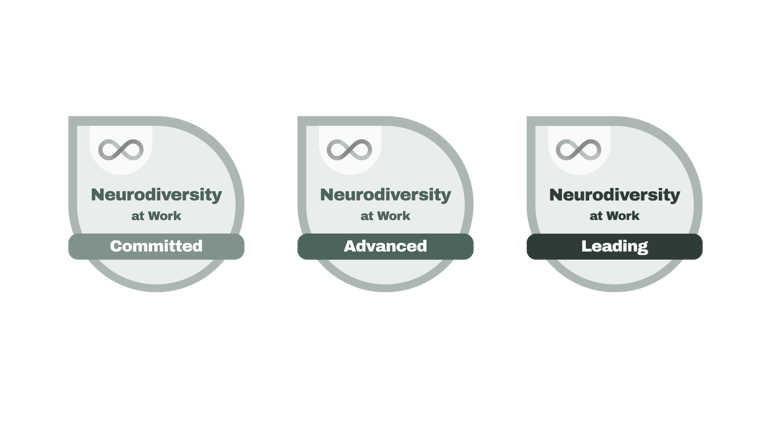
- Committed
For organisations that have demonstrated a strong commitment to creating a neuroinclusive workplace. Solid foundations are in place, including executive sponsorship, clear goals, and a prioritised roadmap for action. Neurodiversity awareness and neuroinclusive practices are under development, and there is work being done towards creating an environment where all types of minds can thrive.
- Advanced
For organisations that have made significant progress in creating a neuroinclusive workplace. Many enabling practices are established across key aspects of work. Neuroinclusive capability, culture, systems, and oversight are evidenced in many areas, and there is clear commitment to further work to create an environment where all types of minds can thrive.
- Leading
For organisations that demonstrate industry-leading neuroinclusive practices across most aspects of work. These are supported by excellent neuroinclusive capability, culture, systems, and oversight. Practices are embedded across the organisation and continuously improved, creating an environment where all types of minds can thrive.
The Human Fabric Neuroinclusion framework
The accreditation is based on a framework which assesses ten crucial areas impacting employee experience and performance. These are shown on the diagram below:
.png?width=1080&height=1350&name=network%20framework%20(1).png) For a workplace to be neuroinclusive, all of these areas must be considered. In each one, Human Fabric assesses current alignment with leading practice, highlights what the organisation is already doing well, and makes recommendations for improvements. This is turned into a prioritised three year plan; a roadmap for organisations to follow.
For a workplace to be neuroinclusive, all of these areas must be considered. In each one, Human Fabric assesses current alignment with leading practice, highlights what the organisation is already doing well, and makes recommendations for improvements. This is turned into a prioritised three year plan; a roadmap for organisations to follow.
The process also includes setting neuroinclusion goals that connect with your people strategy and organisational strategy, as well as identifying measures of success to monitor progress along the way.
The accreditation process
The process of planning, assessment, report and strategy development, and accreditation award generally happens over a month or two, depending on the size and complexity of the business. Carried out either virtually, or in-person, it looks like this:
- We begin with a discovery call, during which the Human Fabric team can get to know and understand your drivers and business context, then provide a quote based on the size of your organisation, along with our standard contact agreement.
- Signing of the accreditation contract allows us to get underway officially!
- The kick-off meeting lasts 60 minutes and will involve planning for the assessment process, agreeing on stakeholders, and identifying supporting documents and data.
- Deploying Human Fabric’s optional anonymous employee survey helps you to gain helpful insight of lived experiences, unless you have already completed something similar.
- A series of collaborative assessment workshops (usually 6 at 30-120 minutes each over several weeks) helps to establish a baseline of what’s working, align ratings against the framework, collaborate on ideas for improvement, and define what success will look like. Each workshop has a different focus and also provides an opportunity to share leading practices with key stakeholders.
- Over 2-3 weeks, Human Fabric will prepare a summary report and neuroinclusion strategy.
- There’s opportunity for you to review the draft report findings and recommendations and address anything that doesn’t feel right before the report is finalised.
- Lastly we hold a leadership and stakeholder presentation, during which we walk through key findings and recommendations and present the executive sponsor with the
Accreditation award! Your organisation is recognised as Committed, Advanced, or Leading, and you are placed on the Neurodiversity at Work website register.
But that is just the beginning. The accreditation comes with 8-20 consulting hours per year for the duration of the accreditation (depending on organisation size), offering advice and support on specific neurodiversity initiatives. There are quarterly survey check-ins (optional) which make the yearly review process simple and easy. Accredited companies receive 6-monthly neurodiversity insights webinars with updates on emerging research and trends and the opportunity to learn from each other too. There are also add-on services available at 20% off standard rates.
Unlock the potential of diversity in your organisation
A commitment to neuroinclusion is an investment in the performance, wellbeing, and retention of your most valuable asset: your people. The Neurodiversity at Work Accreditation will help you to identify gaps in your processes and policies, address barriers to engagement, gain valuable understanding, and create an environment where all your staff can contribute to their full potential.
The accreditation also offers a visible acknowledgement and advertisement of your efforts to pursue inclusivity. We believe that companies who do the mahi should be recognised for it, and are happy to put our name behind that.
Want to talk about becoming a certified neuroinclusive workplace? Book a discovery call today and get the ball rolling.